
Higher Tobacco Taxes Can Save Lives. But Cessation Must Remain the Goal
Following today’s webinar on tobacco taxation in Kenya, Karambu Muthaura examines the modelled health and equity gains, the assumptions behind them and why cessation must remain the goal.
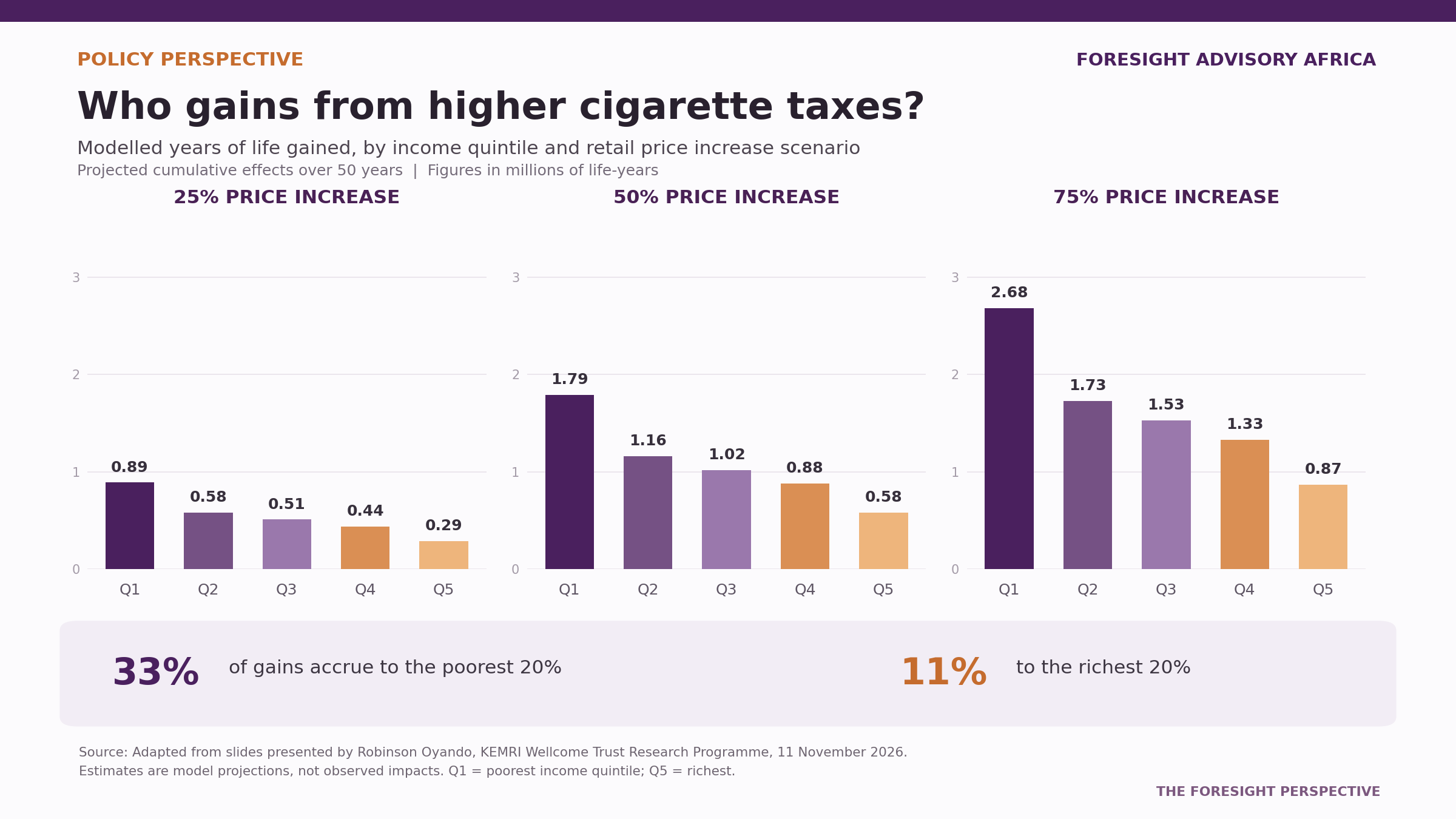
What would a substantial rise in cigarette excise duty achieve in Kenya? Would it reduce tobacco use, protect households from medical expenses and raise revenue? More importantly, would it help people quit?
These questions came into focus during a webinar on 11 November 2026, when Robinson Oyando of the KEMRI Wellcome Trust Research Programme presented modelling of the potential health, revenue and financial protection effects of higher cigarette taxes. The presentation, titled Modelling the Potential Impacts of Increasing Tobacco Excise Taxes in Kenya: Implications for Primary Prevention of Non-Communicable Diseases and Health Financing, offers a useful starting point for policy debate.
The important question is not whether higher taxes can deliver revenue. It is whether Kenya can design and administer them in a way that advances the ultimate purpose of tobacco control: preventing initiation, supporting cessation, protecting people from tobacco exposure and reducing avoidable disease and death.
What the model projects
The study used extended cost-effectiveness analysis, a method that examines not only health gains but also who receives them and whether households avoid healthcare costs. Its dynamic cohort model considered current and future smokers across five age groups and five income quintiles over 50 years. The scenarios involved one-off increases in specific excise duty sufficient to raise cigarette retail prices by 25%, 50% or 75%, assuming the tax increases were fully passed on to consumers.
In the 75% retail price increase scenario, the presentation reported the following modelled cumulative outcomes over 50 years:
- 8.1 million additional life-years gained.
- US$27.2 billion in additional excise revenue.
- US$1.71 billion in tobacco-related treatment costs averted.
- Approximately 268,000 cases of catastrophic health expenditure averted, using a 10% household expenditure threshold.
These are scenario estimates, not measured impacts or a forecast of next year’s collections. The long time horizon and the assumptions about tobacco use, price responses and market behaviour are central to interpreting them. The estimates should not be converted into annual budget expectations by simply dividing by 50. As described in the presentation, the health gain estimates focus on smokers who quit and do not include benefits from reduced second-hand smoke exposure or productivity gains.
The equity finding is important, but not automatic
The distribution of projected health gains deserves close attention. In the model’s main scenario, the poorest income quintile accounted for approximately 33% of life-years gained, compared with 11% for the wealthiest. The poorest group also received around 35% of the total treatment cost savings. This suggests that well-designed tobacco taxation can deliver disproportionately large health benefits to lower-income households.
But the immediate financial burden cannot be dismissed. Under the 50% price increase scenario, projected excise payments amounted to approximately 2.8% of income for the poorest quintile, compared with 0.2% for the wealthiest. For smokers who continue purchasing cigarettes, higher prices may put additional pressure on household budgets.
The right assessment therefore considers both sides: the burden on continuing users and the gains accruing to those who reduce consumption or quit. An equitable tobacco tax policy should make it easier for lower-income smokers to stop, rather than simply require them to pay more.
A sensitivity test changes the picture
One of the most revealing slides was the sensitivity analysis. The main model allowed price responsiveness to vary by income group, with poorer consumers assumed to respond more strongly. The researchers then tested a uniform price elasticity of minus 0.42 across all income groups. Elasticity describes how much consumption changes when prices change.
Under the 75% price increase scenario, that change in assumption reduced projected life-years gained from 8.1 million to 5.1 million. At the same time, estimated additional excise revenue increased from US$27.2 billion to US$43.3 billion. Projected cumulative household cigarette spending changed from a US$11.0 billion reduction to a US$18.9 billion increase. The share of life-years gained by the poorest quintile fell from approximately 33% to 27%.
This contrast matters. A model can project higher revenue even when it produces fewer health gains, if consumers are assumed to respond less to price. The apparent distributional benefit also depends partly on whether lower-income smokers are more price-responsive. These are reasons to strengthen Kenya-specific evidence on smoking behaviour and cessation, not reasons to reject taxation.
They also explain why a health tax should not be judged by revenue yield alone. A smaller long-term tobacco tax base can be consistent with policy success when it reflects sustained reductions in tobacco use.
Price increases are not the same as excise rate increases
The presentation’s 25%, 50% and 75% scenarios refer to retail price increases. They are not equivalent percentage increases in the statutory excise rate. In the model’s illustrative 75% scenario, the price of a pack of 20 cigarettes rose from US$3.00 to US$5.25, while the excise component rose from US$0.57 to US$2.82. Excise therefore increased from around 19% to 54% of the modelled retail price.
The 70% excise share reference shown on the slide is consistent with the Economics for Health Cigarette Tax Scorecard benchmark. It should not be confused with the separate WHO benchmark of at least 75% total taxes as a share of retail price. Excise and total tax shares measure different things.
Tax design matters because firms may absorb part of an increase, raise prices by more than the tax change, or preserve cheaper brands that facilitate downtrading. Taxes must also be assessed against inflation and income growth. A nominal increase does not necessarily make cigarettes less affordable over time.
A separate 2026 Kenyan tobacco taxation report using the Tobacco Excise Tax Simulation Model similarly emphasises sustained tax reform and affordability. That analysis is useful supporting context, but its shorter time horizon and different modelling approach mean it is not a direct validation of the KEMRI Wellcome Trust projections.
Cessation is the goal, not merely a change of product
A question during the webinar raised the possibility that higher cigarette prices could lead some users to switch to cheaper tobacco brands, novel nicotine products, cannabis or khat. The concern is worth investigating, but those behaviours should not be treated as equivalent. Switching within the cigarette market, using alternative nicotine products and using other psychoactive substances involve different risks and require different evidence.
The available slides do not show whether these substitution pathways were explicitly modelled. It would therefore be inappropriate either to claim that the study rules them out or to assume that higher cigarette prices necessarily cause them.
Tobacco control must go beyond lower cigarette sales. Its purpose is to prevent tobacco use from starting, protect non-users from exposure, support people to quit and reduce tobacco-related illness and death. Progress in quitting combustible tobacco is important, but ongoing nicotine dependence, dual use and product switching should be monitored separately rather than concealed within headline sales figures.
That requires taxation to work alongside coherent product regulation, restrictions on promotion, public education and accessible cessation services. In June 2026, Kenya’s Ministry of Health, with WHO support, developed a first full draft of revised national tobacco cessation guidelines. That work offers a timely opportunity to connect fiscal measures with counselling, behavioural support and evidence-based treatment.
Higher tobacco prices can create an incentive to quit. The health system must help turn that incentive into sustained cessation.
Administration and political economy determine what happens next
Tax measures operate in a real market. Their effect depends on correct product classification, accurate production and import declarations, price behaviour, controls against illicit trade and the quality of enforcement. Kenya’s excise stamps and track-and-trace arrangements are valuable, but digital records must be reconciled with production, customs, tax return and market surveillance information.
An excise stamp should not be mistaken for proof that a product complies with every public health requirement. Tax compliance and compliance with packaging, advertising, age-of-sale and other tobacco control rules require coordinated but distinct oversight.
The presentation also pointed to a forthcoming political economy phase, supported by the Alliance for Health Policy and Systems Research, to examine barriers to alcohol and tobacco tax reform in Kenya. This is an important extension. Evidence of potential benefit is not sufficient if industry influence, institutional fragmentation, fiscal incentives or competing policy priorities prevent reform from being adopted and sustained.
What Kenya should do
- Set clear health objectives for excise policy. Evaluate cigarette affordability, initiation, cessation and disease outcomes alongside revenue, and build predictable inflation and income adjustments into tax design.
- Make cessation support a practical part of tax reform. Expand access through primary care, counselling and evidence-based treatment, with particular attention to lower-income users.
- Monitor substitution rather than speculate about it. Track switching to cheaper cigarette brands, novel tobacco and nicotine products, dual use and other substance use using appropriate surveillance and research methods.
- Use joined-up compliance intelligence. Analyse production, stamp, customs, returns and market data together, while maintaining the distinction between tax compliance and tobacco control enforcement.
- Test the assumptions behind long-term projections. Publish the inputs, price elasticities, uncertainty ranges and treatment of illicit trade, future smokers and discounting, and update them as Kenyan evidence improves.
The measure of success
The modelling presented by Robinson Oyando contributes to the evidence that well-designed tobacco taxes can deliver important benefits for Kenya, especially for households with the least capacity to bear the consequences of tobacco-related disease. Its equity analysis and sensitivity tests also make a broader point: the size and distribution of those gains depend on assumptions and on how policy is implemented.
The ultimate objective is not to make tobacco expensive while leaving dependence untouched. It is to prevent initiation, support cessation and protect people from tobacco-related harm. Revenue can help finance public services, including prevention and treatment, but it should serve the public health purpose rather than displace it.
The strongest test of a tobacco tax is not how much more it collects, but whether fewer people start using tobacco, more people successfully quit, and fewer households suffer avoidable illness and financial hardship.
Source and methodology note
This is an independent policy analysis of selected slides presented by Robinson Oyando of the KEMRI Wellcome Trust Research Programme on 11 November 2026. The model projections and sensitivity estimates are attributed to the presenter. The full study manuscript, model specification and underlying datasets were not available for this review. No endorsement by the research team is implied.
Sources and further reading
Oyando, R. (11 November 2026). Modelling the Potential Impacts of Increasing Tobacco Excise Taxes in Kenya. Webinar presentation, KEMRI Wellcome Trust Research Programme. Selected slides viewed during presentation.
World Health Organization. Tobacco control: Raise taxes on tobacco.
Economics for Health (2025). Cigarette Tax Scorecard, 4th edition.
World Health Organization (2024). WHO clinical treatment guideline for tobacco cessation in adults.
Join the conversation
Share a perspective, ask a question, or reply to a reader below.
No comments published yet. Be the first to share your perspective.
Leave a comment
Readers’ comments and replies are reviewed before publication. Please keep the discussion respectful and relevant. Your chosen name and comment will be public once approved. No email address is required.