
The Tax on Getting Paid: Is Kenya Making Digital Business More Expensive?
VAT on specified payment-service fees and excise duty on qualifying transfer and internet services raise a wider question: what is the cost of digital participation for Kenya’s small businesses?
Kenya has spent years encouraging businesses and consumers to embrace digital payments. Mobile money, electronic banking and merchant payment platforms have transformed commerce, improved convenience and created transaction records that can support better financial management and tax compliance.
The VAT treatment of payment-processing services raises an important policy question: are we increasing the cost of participating in the very digital economy that public policy seeks to expand? The question deserves closer attention when considered alongside existing excise duties on specified financial transactions and telecommunications services.
The Finance Act, 2026 clarified the scope of the VAT exemption for financial services. KRA explains that fees charged by payment service providers for digital payment processing, settlement, merchant acquiring, gateway and aggregation services are not exempt. The standard VAT rate is 16%. Crucially, VAT applies to the taxable service fee, not to the full value of the payment. It should not be confused with a blanket 16% VAT on ordinary money transfers.
The case for taxation
The case for taxing these services deserves consideration. Payment intermediaries provide commercially valuable services and earn fees for doing so. Clear VAT rules can reduce uncertainty, support consistent treatment and protect the tax base.
But determining that a service is taxable is not the end of policy analysis. We must also ask who bears the cost, whether businesses can recover the VAT and how the change may influence their behaviour.
The unequal effect on businesses
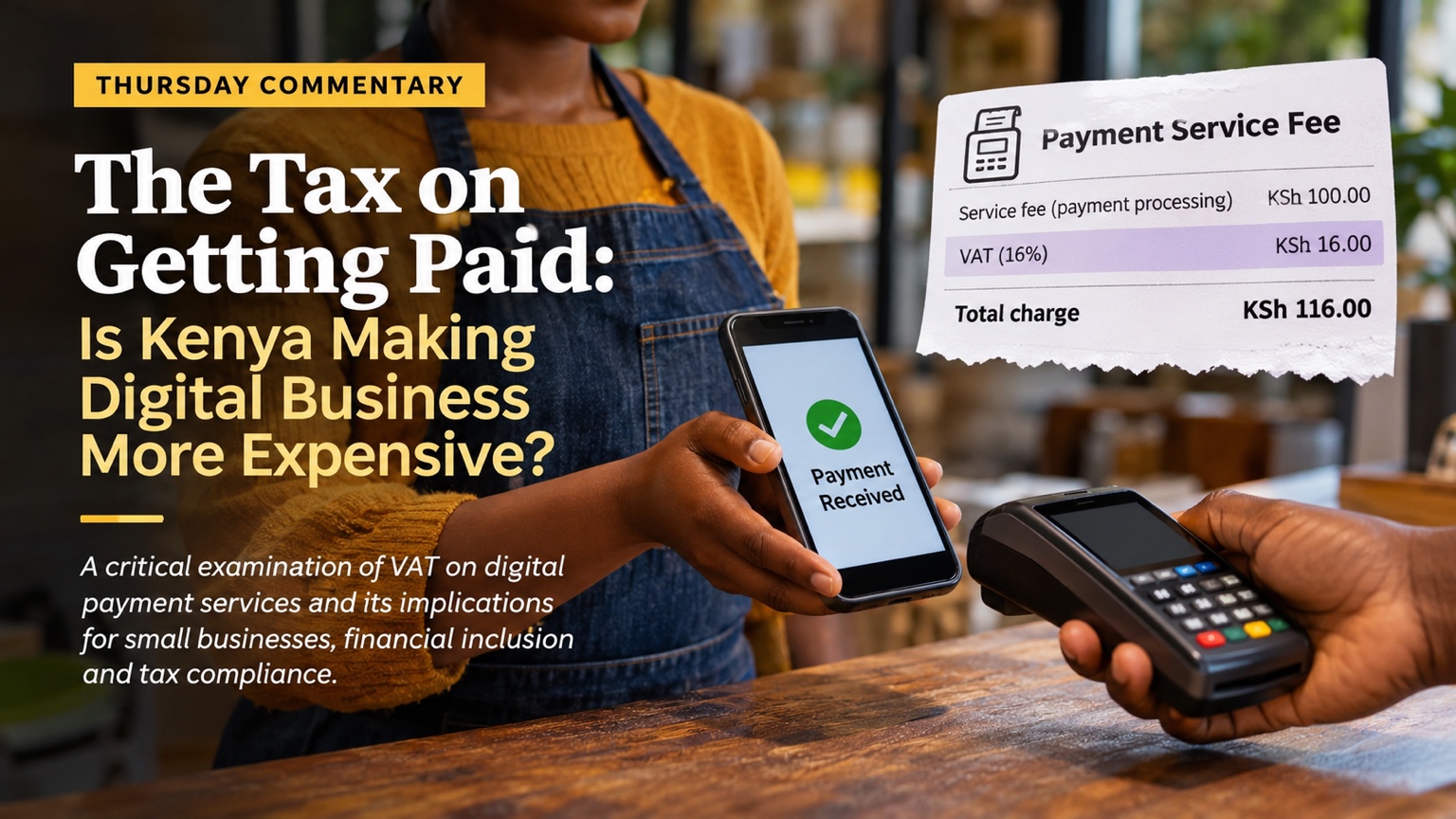
Consider a business charged KSh 100, before VAT, for a taxable payment-processing service. If the provider passes on the full 16% VAT, the invoice becomes KSh 116. This is an illustration of the tax on a service fee, not a charge on the value of goods sold or funds received.
A VAT-registered business using the service to make taxable supplies may be entitled to deduct input VAT, subject to the law's requirements. A business that is not registered for VAT cannot claim that deduction. Where the service is used to make exempt supplies, the related input VAT is generally not deductible; mixed-use costs may require apportionment. To the extent that the VAT cannot be recovered, it becomes part of the cost of accepting payment.
The burden is therefore not uniform. A larger registered business may be able to recover the tax, while a small trader operating on thin margins may have to absorb the charge or pass it to customers. This difference matters when assessing the fairness and practical impact of the measure.
Excise duty is already part of the cost
The VAT treatment of payment services does not operate in a tax-free digital marketplace. Excise duty already applies to specified telecommunications services, including internet data, and to qualifying fees charged for money-transfer services. These are distinct categories of excisable services, with their own statutory definitions, rates and tax bases.
Excise duty on a qualifying money-transfer service is charged on the relevant service fee, not on the amount transferred. Likewise, VAT on taxable payment-processing services is not a blanket tax on the value of every digital payment. The two taxes do not automatically apply together, and the legal treatment of each service must be established separately.
For a small merchant, the concern is the overall cost of operating digitally. Depending on the services used, a business may pay excise-inclusive transfer fees, purchase internet connectivity subject to excise duty, and incur VAT on taxable payment-processing charges. These are different costs arising at different points in business activity, not necessarily two taxes imposed on one transaction.
The policy issue is therefore broader than the VAT amendment itself: how much does the tax system add to the cost of digital participation, and does that cost fall disproportionately on smaller businesses?
Will businesses change how they accept payments?
Digital payment records can make reconciliation easier, improve accountability and support compliance. These are benefits for traders as well as for revenue administration.
However, payment choices are sensitive to costs and convenience. If the total cost of accepting digital payments rises, some merchants may encourage cash or shift charges to customers. That is a plausible risk, not evidence that the VAT change has already caused a move away from digital payments.
The relevant question is empirical: how much of the VAT is passed on, which merchants face higher effective costs, and does this materially change payment behaviour? Those questions require data rather than assumption.
Tax policy must be coherent
Kenya has legitimate revenue needs. Equally, it has policy objectives concerning financial inclusion, business formalisation, digital connectivity and efficient tax administration. These objectives should be assessed together, rather than considering each tax measure in isolation.
An additional tax on a payment-processing fee might raise revenue without materially affecting uptake. Alternatively, in markets where merchant charges are already a barrier, it could add to the costs of formal transactions. Both possibilities deserve examination.
The fact that a tax is administratively collectible does not, by itself, establish that its overall economic effects are desirable.
What should be done?
First, the National Treasury and Kenya Revenue Authority should provide clear, accessible guidance on the exact scope of taxable payment services and the distinction from exempt transactions.
Second, providers should disclose service fees and VAT separately so merchants can understand the true cost of each payment channel.
Third, policymakers should assess the incidence of the tax across VAT-registered and unregistered businesses, including whether providers absorb any of the additional tax and whether merchants alter their pricing or payment preferences.
A wider review should also consider excise duty on qualifying transfer fees and internet services. The objective is to understand the cost of digital participation across different services, without assuming that VAT and excise duty are both payable on every transaction.
Finally, the effects should be reviewed alongside financial inclusion and formalisation objectives. A review need not presume that the tax must be repealed. Its purpose should be to establish whether the measure delivers revenue efficiently and with acceptable economic costs.
The bigger question
Kenya's digital economy offers substantial opportunities for businesses and tax administration. A well-designed tax system should help sustain those gains while raising the revenue required to finance public services.
Good tax policy is not measured solely by how much revenue it raises. It must also be judged by the behaviour it encourages, the burdens it creates and its contribution to long-term development.
A country that wants businesses to transact digitally must remain attentive to the cost of doing so.
Sources and further reading
- Kenya Revenue Authority: Finance Act 2026, What It Means for You. Guidance on the scope of exempt financial services and taxable digital payment-service fees.
- Kenya Revenue Authority: Value Added Tax. Standard rate, registration and input VAT deduction.
- Republic of Kenya: Excise Duty Act, 2015, First Schedule, Part II. Statutory framework for excisable services.
- Central Bank of Kenya: National Financial Inclusion Strategy 2025–2028. Policy context on digital transformation and financial inclusion.
Join the conversation
Share a perspective, ask a question, or reply to a reader below.
No comments published yet. Be the first to share your perspective.
Leave a comment
Readers’ comments and replies are reviewed before publication. Please keep the discussion respectful and relevant. Your chosen name and comment will be public once approved. No email address is required.