
Thursday Commentary
Excise Duty Is Not an Industrial Protection Tool: Lessons from Kenya's Sugar Tax
Karambu Muthaura ·
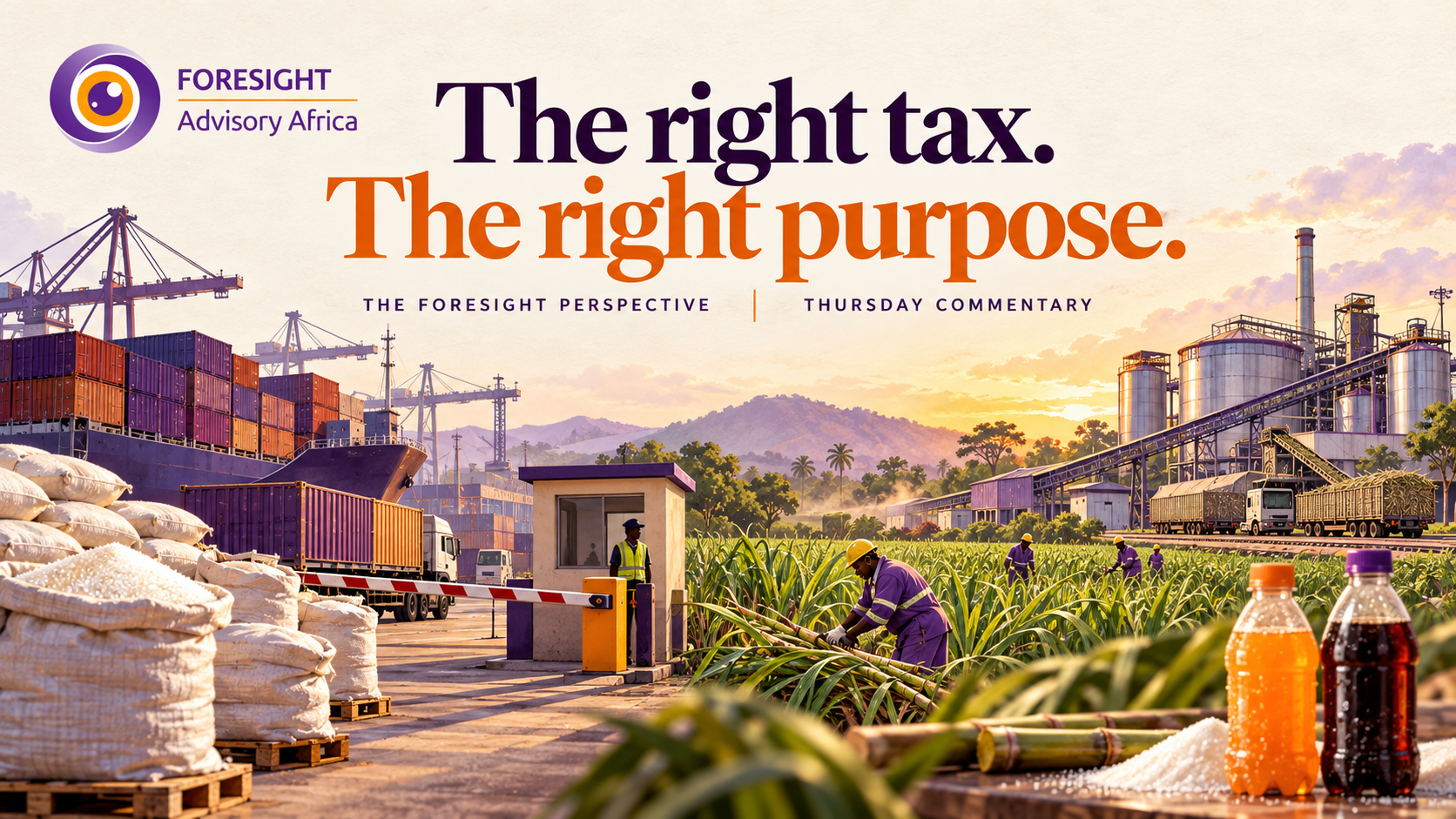
Making imports more expensive is not the same as making domestic producers more competitive.
A tax can be legally imposed, administratively convenient to collect and capable of generating revenue. Yet these qualities alone do not make it a well-designed tax.
Sometimes, the more important question is not how much revenue a tax will collect, but whether it is the appropriate instrument for achieving the government's intended objective.
Kenya's ongoing dispute over excise duty on imported industrial sugar illustrates why this distinction matters.
Under the Finance Act, 2026, excise duty on specified imported sugar increased from KSh 7.50 to KSh 40 per kilogramme, effective 1 July 2026. The increase of approximately 433% has prompted the Kenya Association of Manufacturers (KAM) to challenge the measure in court.
Manufacturers argue that the higher duty increases production costs, threatens employment and undermines their competitiveness. In October, the High Court certified their application as urgent, although this procedural decision did not determine the merits of the petition.
Beyond the legal proceedings, the dispute raises three fundamental questions. Should excise duty be used to protect domestic producers? If Kenya's sugar industry requires support, are there more effective ways of strengthening it? And should a tax on imported sugar be presented as a public health intervention?
These questions go to the heart of sound tax policy.
Excise Duty Is Not a Substitute for Customs Duty
Excise duty is a selective tax imposed on specified goods and services. It is principally used to raise revenue and can also address negative externalities associated with products such as tobacco, alcohol and sugar-sweetened beverages.
It should not be used as a substitute for customs duties or other trade protection measures.
Customs duties are imposed on imported goods and may, within applicable trade agreements, be structured to protect domestic industries from foreign competition.
Excise duty, on the other hand, is an internal tax. Although it may be collected at the point of importation, its application is subject to the principles governing internal taxation, including non-discrimination between imported and comparable domestically produced goods.
This distinction is not merely theoretical.
Article III of the General Agreement on Tariffs and Trade (GATT) establishes the World Trade Organization's principle of national treatment.
Article III(1) recognises that internal taxes should not be applied to imported or domestic products so as to afford protection to domestic production. Article III(2) prohibits internal taxation of imported products in excess of that imposed on like domestic products and also addresses protective taxation of directly competitive or substitutable products.
The GATT further clarifies that an internal tax does not cease to be an internal tax merely because it is collected at the point of importation.
This principle has direct implications for excise tax policy.
Where excise duty is imposed on imported products while like domestic products are not subjected to equivalent taxation, a serious question arises about compliance with the WTO national-treatment principle.
The fact that a tax is described in national legislation as excise duty does not shield it from international trade obligations.
In Kenya's case, the distinction between imported industrial-grade sugar and domestically produced sugar requires careful examination. A legal assessment would need to establish whether the products are like, or directly competitive or substitutable, and consider their actual tax treatment.
This article does not conclude that Kenya has violated WTO rules. That determination requires a proper examination of the relevant law, products and facts.
However, the national-treatment principle raises an important policy concern that should not be overlooked.
Excise duty should not be designed or applied as a disguised instrument of protection for domestic production.
If the objective is to protect local producers from import competition, that objective should be addressed openly through the appropriate trade and industrial policy frameworks, within Kenya's international and regional obligations.
Protecting Domestic Producers Is Not the Same as Making Them Competitive
The desire to support Kenya's domestic sugar industry is understandable.
Sugar production sustains agricultural livelihoods, supports manufacturing employment and contributes to economic activity in several regions of the country.
However, acknowledging the importance of the industry does not mean that every measure intended to protect it is necessarily appropriate.
The first question should be why domestic producers struggle to compete.
If the challenges arise from low agricultural productivity, inefficient milling operations, expensive energy, inadequate infrastructure, high financing costs or outdated technology, imposing additional taxes on imports does not resolve those problems.
It merely makes imported alternatives more expensive.
Making imported sugar more expensive does not automatically make Kenyan sugar cheaper or more efficient to produce.
Where border protection is genuinely necessary and justified, governments have trade policy instruments available, including customs tariffs and, where the statutory conditions are met, trade remedies such as anti-dumping, countervailing and safeguard measures.
But these instruments should not become substitutes for addressing the underlying constraints affecting domestic production.
Protection may provide breathing space for an industry. What matters is whether that opportunity is used to build productive capacity and competitiveness.
Kenya's sugar industry requires an enabling business environment that makes local production efficient, reliable and commercially viable.
That means improving access to high-yielding sugarcane varieties, strengthening agricultural extension services, investing in irrigation and rural infrastructure, and reducing the cost of transporting sugarcane to factories.
It means facilitating affordable financing, reliable and competitively priced energy, modern milling technology, efficient logistics and timely payment to farmers.
It also means predictable regulation, accountable industry institutions, investment in research and innovation, and policies that encourage value addition.
These measures address the actual determinants of production costs, quality and competitiveness.
Importantly, this is not an entirely new policy proposition.
The Kenya Sugar Board's Strategic Plan for 2025–2027 identifies low farm productivity, inefficient milling operations, weak governance and other structural challenges that have constrained the sector's performance.
The Sugar Act, 2024 also establishes mechanisms intended to support the industry's development.
Under Section 40, the Sugar Development Levy provides dedicated resources for cane development and productivity enhancement, factory development and rehabilitation, research and training, infrastructure, industry administration and farmers' organisations.
The Act allocates 40% of levy proceeds to cane development and productivity enhancement, 15% to factory development and rehabilitation, 15% to research and training, and 15% to infrastructure development and maintenance in sugarcane-producing regions. The remaining 15% supports the Board's administration and farmers' organisations.
The levy applies to domestic and imported sugar under the relevant implementing order. It is a separate instrument from the excise duty on specified imported sugar.
The challenge, therefore, is not necessarily the absence of policy instruments or development frameworks.
It is ensuring that the available resources and institutions deliver measurable improvements in productivity, processing efficiency, cost competitiveness and product quality.
The ultimate objective of supporting domestic producers should be to make them sufficiently competitive to succeed, not to create permanent dependence on fiscal barriers against competing products.
An industry should become stronger because the conditions for producing efficiently have improved, not merely because its competitors have been made more expensive.
Protecting One Industry Should Not Weaken Another
There is a further complication in the case of industrial sugar.
Sugar is not only a finished product purchased by households. It is also an input used in manufacturing beverages, confectionery, pharmaceuticals and other products.
Manufacturers may require specific grades and qualities of sugar that differ from those commonly available for household consumption.
KAM argues that the industrial-grade sugar required by its members is not produced locally at commercial scale.
If this position is established, imposing higher excise duty on imported industrial sugar may not necessarily increase demand for locally produced sugar.
Instead, it may raise production costs for Kenyan manufacturers that rely on that input.
This creates a potential contradiction.
On the one hand, Kenya seeks to promote local manufacturing, value addition, investment and exports. On the other, increasing the cost of essential industrial inputs may weaken the competitiveness of those same manufacturers.
The consequences may include higher consumer prices, reduced margins, lower production or reduced competitiveness in regional export markets.
Section 14 of Kenya's Excise Duty Act provides for the offset of excise duty paid on qualifying raw materials used in manufacturing other excisable goods.
This mechanism is important because it helps prevent the accumulation of excise duty along qualifying production chains.
However, it is not a general input-tax credit available to every manufacturer. Where the finished product is not excisable, the ordinary offset mechanism does not apply. Even where relief is available, manufacturers may experience working-capital pressures before the offset is realised.
It would therefore be inaccurate to assume that every manufacturer faces double taxation. Equally, the existence of a statutory offset does not mean that taxing industrial inputs has no economic consequences.
An industrial policy that protects sugar producers while increasing production costs for industries that use sugar risks shifting economic burdens rather than solving the underlying competitiveness problem.
Sound industrial policy should consider the entire value chain, not simply the interests of one segment.
Imported Sugar Is Not a Health Tax Simply Because It Contains Sugar
There is another distinction that deserves attention.
Excessive consumption of sugar contributes to important public health concerns, including obesity, diabetes and other diet-related noncommunicable diseases.
However, this does not mean that every tax imposed on sugar is a health tax.
A health tax must be assessed against its intended public health objective and the extent to which its design can influence consumption of products associated with health risks.
Kenya's excise duty on specified imported sugar is not imposed in the same manner on domestically produced sugar.
This raises an obvious question.
If the objective is to reduce sugar consumption for public health reasons, why should the tax treatment depend on whether the sugar was imported or produced locally?
Sugar does not become less harmful because it was produced within Kenya's borders.
A tax that distinguishes products primarily by origin, rather than by their contribution to the health risk being addressed, is difficult to justify as a coherent health tax.
It may have a revenue or industrial policy rationale, but those objectives should be clearly stated and assessed on their own merits.
This distinction is particularly important because there is a well-established public health case for taxing sugar-sweetened beverages.
The World Health Organization recommends taxes on sugar-sweetened beverages as part of policies to promote healthier diets and reduce diet-related noncommunicable diseases.
Such taxes aim to increase the relative prices of sugar-sweetened beverages, discourage excessive consumption, encourage healthier choices and provide incentives for manufacturers to reformulate their products.
The appropriate focus of a sugar-sweetened beverage health tax is the beverage placed on the market, not the country of origin of the sugar used in its manufacture.
A properly designed beverage health tax should cover relevant products whether they are manufactured locally or imported.
Its structure should take account of product coverage, sugar content, appropriate rates, administrative feasibility and the intended behavioural response.
Where feasible, linking tax liability to sugar content can strengthen incentives for manufacturers to reduce the amount of sugar in their products.
Kenya's Finance Act, 2026 introduced different excise rates for fruit and vegetable juices with and without added sugar or sweeteners.
Although this distinction is more closely connected to product composition, a comprehensive beverage health tax policy requires consistent treatment across relevant beverage categories and evidence-based assessment of its effects.
We should therefore avoid confusing taxation of imported industrial sugar with taxation of sugar-sweetened beverages for public health purposes.
The presence of sugar in both discussions does not make their policy objectives identical.
Excise Policy Must Be Guided by Its Intended Purpose
The concerns raised by industrial sugar are not isolated.
In July 2026, the Ministry of Investments, Trade and Industry held consultations with KAM over increased excise duties affecting industrial inputs, including sugar, printing inks and resins.
The Ministry acknowledged concerns about manufacturing competitiveness and proposed reviewing the excise regime, with greater emphasis on finished products rather than raw materials.
Recent amendments to the excise treatment of imported ceramic tiles also demonstrate that the choice of tax base matters.
Following concerns about the effect of a weight-based minimum duty, Kenya amended the calculation in October 2026 to use surface area rather than weight.
These developments raise a broader question about whether excise taxation is increasingly being used to pursue objectives that may be better addressed through other policy instruments.
A selective tax should not become a convenient mechanism for pursuing every policy objective simply because the administrative machinery for collecting it already exists.
Tax policy must begin by identifying the problem that government intends to solve.
Only then should policymakers determine which instrument is most appropriate.
This also reinforces the importance of meaningful public participation.
KAM has raised concerns about the process through which the industrial sugar increase was introduced. Whether the process complied with constitutional requirements remains a matter for the courts.
However, good consultation should go beyond procedural compliance.
It should help policymakers understand the problem, examine alternative interventions, assess unintended consequences and establish whether taxation is the appropriate response.
For industrial protection, this means examining domestic production capacity, competitiveness, import dependence and the conditions under which producers operate.
For health taxation, it means examining consumption patterns, health risks, behavioural responses, product substitution and reformulation.
For revenue measures, it means assessing expected collections alongside administrative costs and wider economic consequences.
Different objectives require different evidence and different instruments.
The Right Instrument for the Right Objective
Kenya needs sustainable public revenue. It also needs competitive industries, productive investment, employment and better public health outcomes.
These objectives are not mutually exclusive. However, achieving them requires discipline in the design and application of fiscal and economic policy.
If the objective is to protect domestic sugar producers, government should prioritise addressing the structural constraints that make local production uncompetitive. Where trade protection is justified, it should be pursued through appropriate instruments consistent with Kenya's regional and international obligations.
If the objective is to discourage excessive consumption of sugar-sweetened beverages, an evidence-based, non-discriminatory health tax should target those beverages.
If the objective is to raise revenue, expected collections must be weighed against the effects on production, investment, employment, consumers and other tax bases.
Excise duty remains an important instrument of public finance, but its effectiveness depends on being used for clearly defined and appropriately designed purposes.
The fact that a product can be subjected to excise duty does not establish that it should be.
Kenya's industrial sugar dispute presents an opportunity to revisit a fundamental principle of economic policymaking: government should not rely on a tax instrument to compensate for structural problems that require more comprehensive solutions.
Protecting domestic production should mean creating the conditions in which domestic producers can compete successfully, not merely making imported alternatives more expensive.
That is the difference between protecting an industry and building a competitive one.
And it is why the choice of tax instrument matters.
Good tax policy is not about taxing whatever is available. It is about choosing the right instrument, for the right objective, and applying it in the right way.
References and further reading
- Kenya Revenue Authority — Finance Act, 2026: What It Means for You
- Daily Nation — Manufacturers challenge the industrial sugar excise increase, 8 October 2026
- World Trade Organization — GATT 1994, Article III: National Treatment
- Kenya Sugar Board — Strategic Plan 2025–2027
- Sugar Act, 2024 — Kenya Law
- Ministry of Investments, Trade and Industry — Consultations with KAM, July 2026
- Excise Duty Act, 2015 — Section 14, Relief for Raw Materials
- World Health Organization — Manual on Sugar-Sweetened Beverage Taxation Policies
- Kenya Revenue Authority — Collection of Sugar Development Levy
- Parliament of Kenya — Tax Laws Amendment and the Ceramic Tiles Tax Base
The Foresight Perspective is a publication of Foresight Advisory Africa, offering evidence-based analysis of taxation, public policy, governance and economic development.
Join the conversation
Share a perspective, ask a question, or reply to a reader below.
No comments published yet. Be the first to share your perspective.
Leave a comment
Readers’ comments and replies are reviewed before publication. Please keep the discussion respectful and relevant. Your chosen name and comment will be public once approved. No email address is required.