
Thursday Commentary
Kenya’s Health Taxes Are Losing Their Bite
Karambu Muthaura ·
Article first published on LinkedIn on 16 October 2026.
Kenya has one of the most advanced excise tax administration systems in Africa. We were among the early adopters of digital track-and-trace technology, and delegations from more than 40 countries have visited Kenya to learn from our experience.
That is something worth celebrating.
But there is an uncomfortable question we must ask ourselves: Are we doing as well in using excise taxation to protect health as we are in administering it?
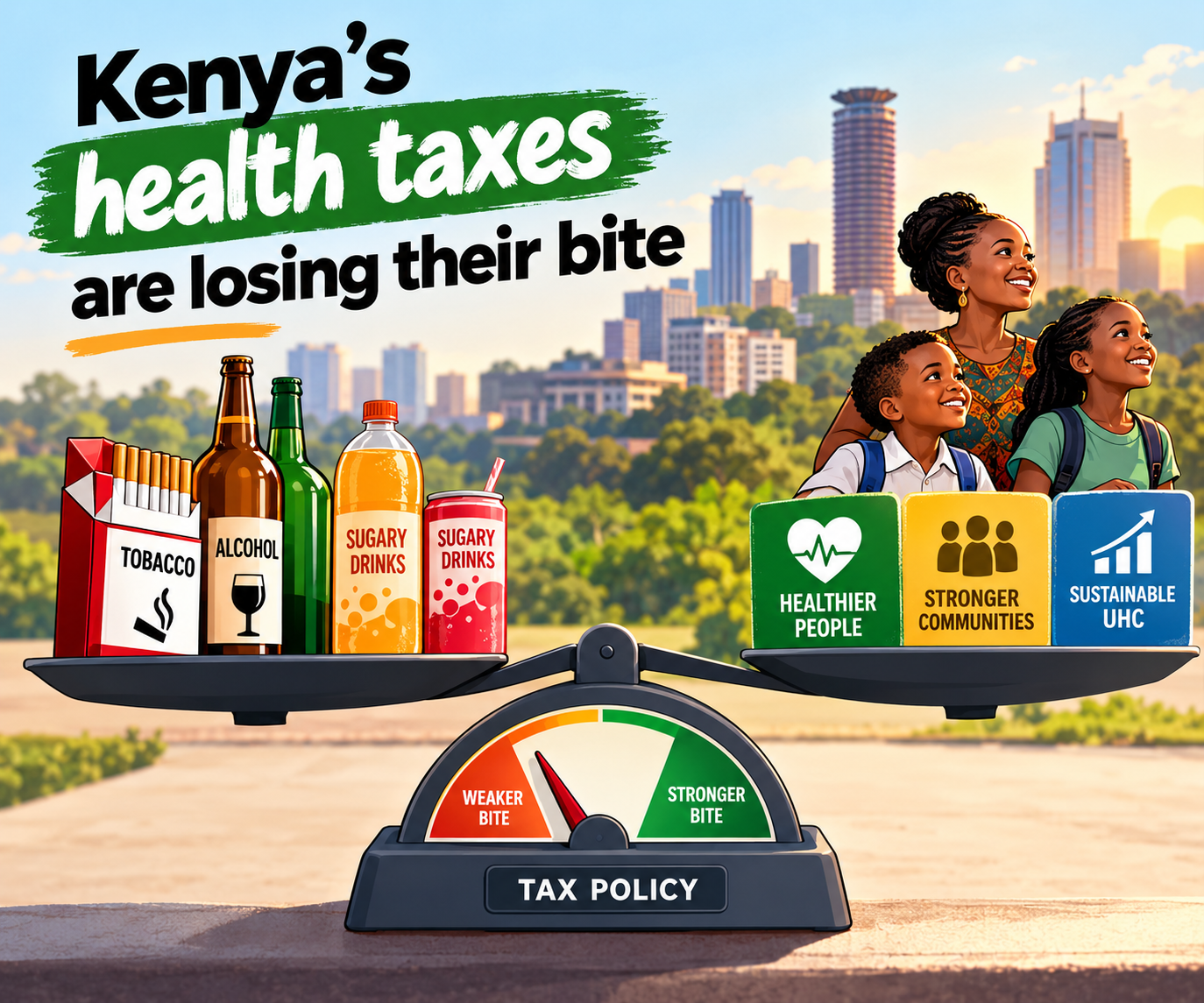
When it comes to tobacco, alcohol and sugar-sweetened beverages, effective health taxation should make harmful consumption less affordable over time. Yet some of our policy choices risk taking us in the opposite direction.
The problem is not always what we do. Sometimes, it is what we stop doing.
In 2023, Kenya repealed the provision for annual inflation adjustments to specific excise duty rates.
It may have seemed like a technical change, but its implications are significant.
A tax fixed at a certain number of shillings per unit gradually loses its real value as prices rise. And when incomes grow faster than the prices of taxed products, those products may become more affordable, undermining the very purpose of the tax.
Nobody has to announce that cigarettes, alcohol or sugary drinks should become more affordable. Without deliberate adjustments, it can happen quietly, budget after budget.
The Finance Act 2026 presents a mixed picture.
The distinction in excise treatment between juices with added sugar and those without is a welcome step towards more health-conscious tax design. It recognises that products should not necessarily receive identical tax treatment when their potential health impacts differ.
However, the increase in excise duty on imported sugar raises a different policy question.
A tax primarily designed to protect domestic producers is not necessarily a health tax. From a health perspective, the concern is excessive sugar consumption, regardless of whether the sugar is produced in Kenya or imported.
Sugar does not become healthier simply because it is locally produced.
This distinction matters. We should be clear about whether our tax policies are intended to protect industries, raise revenue, improve public health, or achieve a combination of these objectives. Each goal requires an appropriate policy design.
So, how do we put the bite back into Kenya’s health taxes?
1. Restore automatic inflation adjustment of specific excise duty rates
Inflation adjustment should not depend on a political decision every budget cycle. It should be a predictable feature of the tax system.
Regular adjustments would protect the real value of excise revenue and help prevent the gradual erosion of the health impact of specific taxes.
But inflation adjustment alone is not enough. We must also monitor affordability, taking into account changes in product prices and household incomes.
The objective should be clear: products that impose significant health and social costs should not become progressively more affordable simply because tax policy has stood still.
2. Design sugar-sweetened beverage taxes around health objectives
The distinction between juices with and without added sugar is a useful starting point, but Kenya can go further.
We should work towards a coherent approach to taxing sugar-sweetened beverages, with the tax structure informed by sugar content and supported by clear health objectives.
Such an approach could encourage manufacturers to reformulate products, reduce added sugar and offer healthier alternatives.
The principle is simple: where the policy objective is health, the tax should be designed around the health risk, not merely the product category or its country of origin.
3. Make the benefits of these taxes more visible
With Kenya pursuing Universal Health Coverage through the Social Health Authority, and non-communicable diseases placing increasing pressure on households and the healthcare system, there is a compelling case for directing a defined share of health tax revenues towards prevention, treatment, health promotion and research.
This would require careful design within our public finance framework, with transparency and accountability in how the resources are allocated and used.
Earmarking should not replace ordinary healthcare funding. It should supplement it.
An earmark should be a floor, not a ceiling.
When Kenyans can see that taxes on products associated with preventable disease are helping finance healthcare and prevention, the connection between taxation and public welfare becomes more tangible.
The bigger picture
Health taxes offer governments an important opportunity to achieve two objectives at once: raise much-needed revenue and reduce the consumption of products associated with preventable disease.
But these benefits are not automatic. They depend on how taxes are designed, maintained and administered.
Kenya has already demonstrated that it can build sophisticated excise administration systems. We have invested in technology, compliance monitoring and enforcement capacity.
The next challenge is to match that administrative strength with equally strong, consistent and evidence-based health tax policy.
We have built the machinery. Now we must ensure the policy keeps pace.
To colleagues across Kenya and the wider region: How are your countries protecting the real value of health taxes, and what lessons can we learn from one another?
Join the conversation
Share a perspective, ask a question, or reply to a reader below.
No comments published yet. Be the first to share your perspective.
Leave a comment
Readers’ comments and replies are reviewed before publication. Please keep the discussion respectful and relevant. Your chosen name and comment will be public once approved. No email address is required.